2026 Update, Best Upload Settings for Youtube
Summary,
Don't upload 1080p. 4K and 1440p seem practically equivalent.
YT will accept high bitrate DnxHR HQX files, and if you have a very strong internet connection, you can just upload these and save the encoding time.
If you have hardware encoding for AV1, it at 60 mbit 10 bit seems to be the best image quality for reasonable file sizes.
Otherwise H.265 60 mbit 10 bit produced the best VMAF scores outside DnxHR and would be my choice if lacking HW encoding for AV1.
It appears that 60fps uploads do not need additional bitrates over 24fps to get good results on YT and either of the two recommendations above work well for 24 and 60fps.
The question I seek to answer is how to get the best image quality we can on Youtube and do it with reasonable size files to upload. I did a similar test 3 years ago, and want to run again and see maybe if YT has changed something on their end.
https://www.zebgardner.com/photo-and-video-editing/youtube-image-quality-vmaf
I don't have the original files from my test 3 years ago. So this will not be a direct comparison to that, hopefully these test files are actually more representative to wider use cases.
I took seven different clips of 10 seconds each and put on a 24fps 4k timeline. Intention being to see if the different files produce different results ( I was not going to upload 7 different files for each test to YT, so they were merged to one.)
RTS (Victoria 3) game footage capture
FPS (Fallout 4) game footage capture
Drone Footage, normal speed
Slow Panning Landscape shot
Drone footage, 10x speed, absurd amount of grain, compression stress test
Moving subject (giraffe stock footage) over very dark background, Shadow test
Talking head, stock footage
I exported this from resolve in DnxHR HQX file that we will use as our master to compare against. This file is 4k, 10 bit and 700mbit/s, 5.7gbyte, and should be essentially visually lossless.
That master was run through handbrake to produce multiple files we will upload to YT and redownload to test how much image quality YT took away vs the master.
Follows were the the test configurations
H.264 100 mbit, X264, 10 bit, Very Slow
H.264 60mbit, X264, 10 bit, Very Slow
H.264 40 mbit, X264, 10 bit, Very Slow
H.265 60mbit, X265, 10 bit, Slow
H.265 60mbit, X265, 8 bit, Slow
H.265 40 mbit, X265, 10 bit, Slow
H.265 20 mbit, X265, 10 bit, Slow
AV1 100 mbit, Nvenc, 10 bit, Slowest
AV1 60mbit, Nvenc, 10 bit, Slowest
AV1 40 mbit, Nvenc, 10 bit, Slowest
VP9 60mbit, 10 bit, Slow
VP9 40mbit, 10 bit, Slow
1080P DnxHR HQX
1440P DnxHR HQX
For #13/14 I took the master file and had FFMPEG chop it to 1080P and 1440p, output to DnxHR HQX, to see if YT treats these resolutions different than 4k.
I also expect most people using game capture footage are not uploading at 24fps. My footage was captured at 60 fps and put on a new 60fps timeline. I exported that again at 60fps and encoded at;
H.265 60mbit, X265, 10 bit, Slow
H.265 100mbit, X265, 10 bit, Slow
AV1 100 mbit, Nvenc, 10 bit, Slowest
AV1 60mbit, Nvenc, 10 bit, Slowest
These clips were all uploaded to my YT channel as hidden, let the 4k process, then redownloaded with YT-DLP in best quality. I only have a few hundred followers, so if YT does give preferential treatment to big channels, I sadly can't test that.
This is the Upload of the 24fps DnxHR HQX File https://youtu.be/Kh1V-YTPyR0
And here are is the 60fps game footage https://youtu.be/OqpsDM4S7II
This is the metadata for the file that YT gives you back. VP9 codec in 4:2:0 8 bits (I uploaded a 10 bit file)
General
Complete name : E:\Source Footage\VMAF\Download\H265_40_mbit_10_bit_Slow.webm
Format : WebM
Format version : Version 4
File size : 141 MiB
Duration : 1 min 10 s
Overall bit rate : 16.9 Mb/s
Frame rate : 23.976 FPS
Writing application : Lavf62.6.100
Writing library : Lavf62.6.100
Video
ID : 1
Format : VP9
Format profile : 0
Codec ID : V_VP9
Duration : 1 min 10 s
Width : 3 840 pixels
Height : 2 160 pixels
Display aspect ratio : 16:9
Frame rate mode : Constant
Frame rate : 23.976 (24000/1001) FPS
Color space : YUV
Chroma subsampling : 4:2:0
Bit depth : 8 bits
Language : English
Default : Yes
Forced : No
Color range : Limited
Color primaries : BT.709
Transfer characteristics : BT.709
Matrix coefficients : BT.709
Audio
ID : 2
Format : Opus
Codec ID : A_OPUS
Duration : 1 min 10 s
Channel(s) : 2 channels
Channel layout : L R
Sampling rate : 48.0 kHz
Bit depth : 32 bits
Compression mode : Lossy
Delay relative to video : 7 ms
Language : English
Default : Yes
Forced : No
FFMetrics was run on each file vs the master to see the quality loss. The 1080/1440p files from YT were compared against their cut resolution master, not the 4k one. FFMetrics has PSNR, SSIM and VMAF, so you don't have to argue about which is best. I have included the charts, so you can see in each 10 second block what the chart looks like for the 7 different 'styles' of footage. VMAF Model 4K 0.6.1 was used
As we are comparing back against the DNXHR master we are seeing how much total quality we lost. What part is lost on YT side vs what was lost in Handbrake, we don't know. But ultimately, I don't care, the intention is what will give the best visual quality at reasonable file sizes to upload to YT.
Follows are all the detailed results;
| Name | PSNR | SSIM | VMAF |
|---|---|---|---|
| AV1 100mbit | 28.72 | 93.34 | 99.26 |
| AV1 60mbit | 28.70 | 93.49 | 99.67 |
| AV1 40mbit | 28.46 | 92.74 | 99.16 |
| H.264 100mbit | 28.53 | 93.07 | 99.07 |
| H.264 60mbit | 28.67 | 93.81 | 98.96 |
| H.264 40mbit | 28.54 | 92.86 | 97.46 |
| H.265 60mbit | 27.98 | 92.39 | 99.75 |
| H.265 60mbit 8 bit | 28.49 | 92.87 | 98.79 |
| H.265 40mbit | 28.60 | 93.31 | 98.84 |
| VP9 60mbit | 28.39 | 92.18 | 99.45 |
| VP9 40mbit | 28.26 | 91.37 | 98.99 |
| 4k DnxHR HQX | 28.85 | 94.33 | 99.92 |
| 1440p DnxHR HQX | 28.71 | 94.08 | 99.95 |
| 1080p DnxHR HQX | 27.58 | 89.12 | 97.32 |
These charts show the scores for each individual frame over time. So the first 240 frames will be test one, the RTS game footage, Frame 241-480 is the FPS footage, etc.
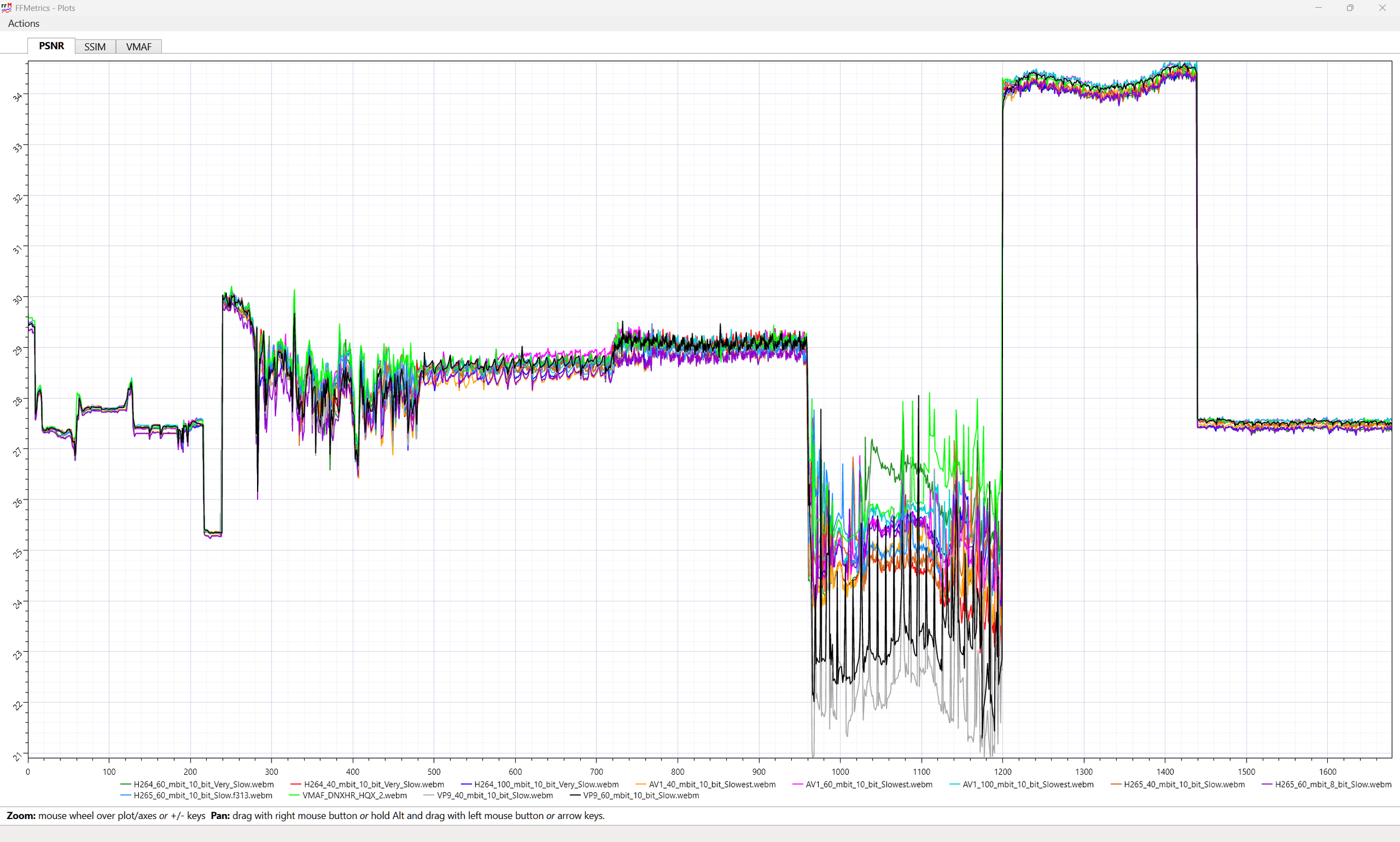
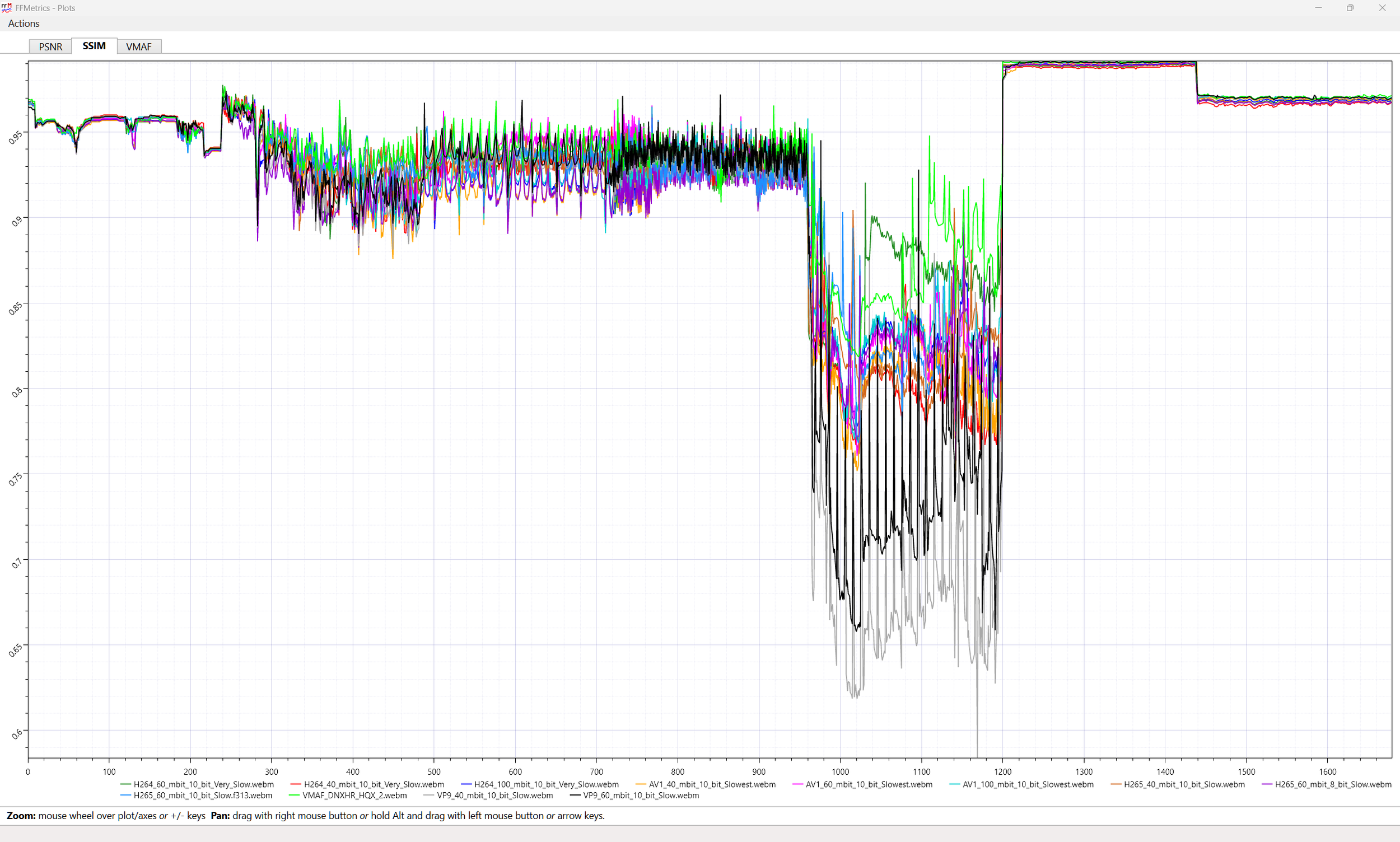
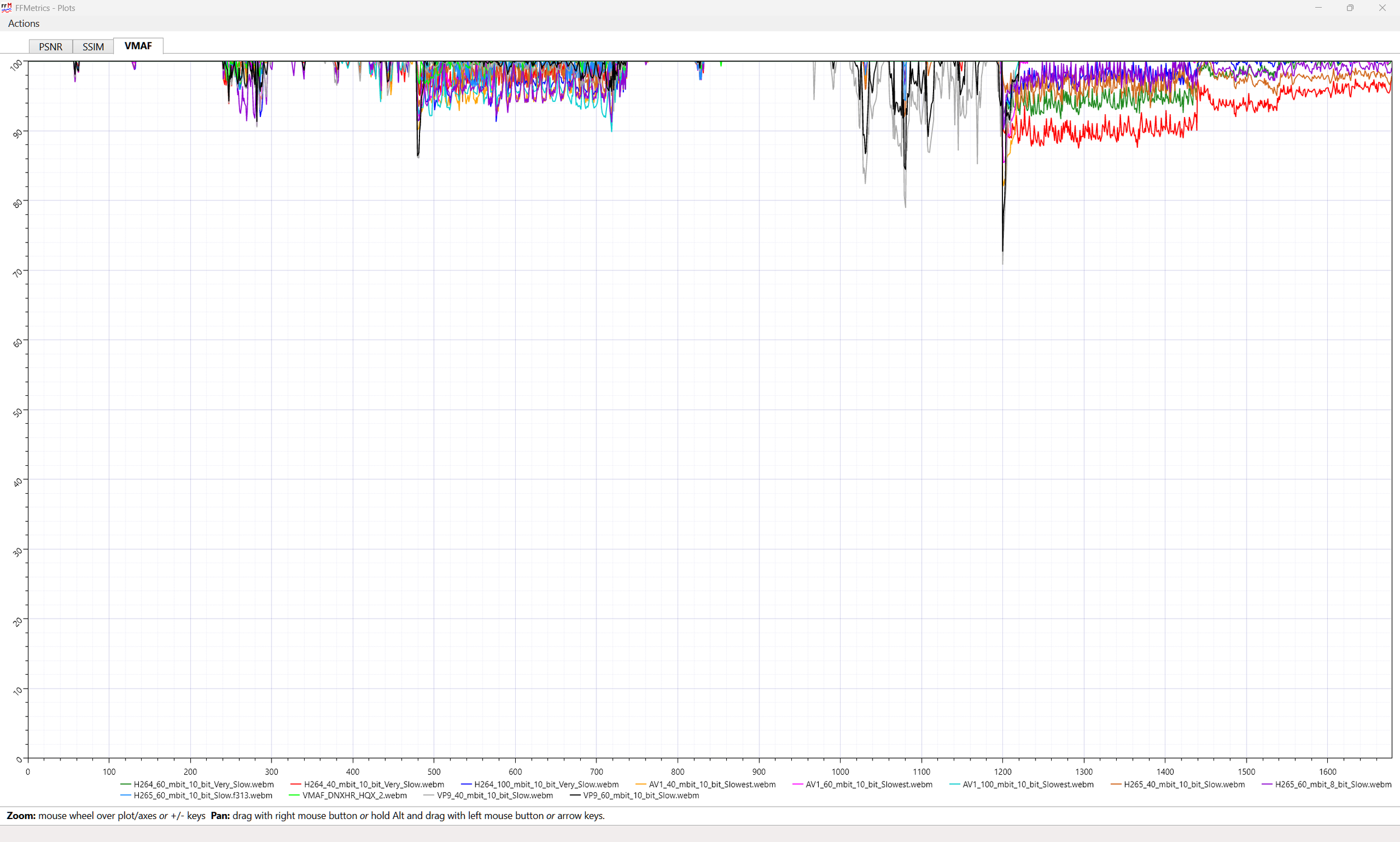
For mean results uploading the DnxHR HQX 4k file was best with
PSNR of 28.85,
SSIM of 94.33
VMAF of 99.92.
The results for DnxHR 1440p were also very good;
PSNR of 28.71,
SSIM of 94.08
VMAF of 99.95.
YT seems to punish 1080p, with it producing the worst scores seen here;
PSNR of 27.58,
SSIM of 89.12,
VMAF of 97.32.
For more approachable file sizes, the H.265 10 bit 60mbit file had best VMAF with
PSNR of 27.98,
SSIM of 92.39,
VMAF of 99.75.
H.265 60 mbit, 8 bit vs 10 bit. 8 bit produced better PSNR and SSIM results than 10 bit, but worse VMAF. YT serves back a 8 bit file either way.
With the newer AV1 codec, at 60mbit produced the better PSNR and SSIM results than H.265 at same bitrate;
PSNR of 28.70,
SSIM of 93.49,
VMAF of 99.67.
Surprisingly, despite VP9 being the codec that YT uses to serve the file back to you in, uploading a 60mbit VP9 produced significantly worse results. Particularly when you look at the line charts, you see the fast motion drone shot with noise was very poor in comparison.
Looking at the line charts for the two OBS game captures, there is really not much difference in any of the 3 metrics. So even a 40mbit h.264/5 upload should produce similar results to a DnxHR HQX upload
Shots 3 and 4, drone footage and landscape, don't show significant differences, but the pink line AV1 60mbit is a generally good performer.
Shot 5, the 10x drone footage with noise, is where the largest spread is seen in the line charts. VP9 being a particularly poor performer. Interestingly, the VMAF test doesn't show as much spread as the SSIM and PSNR with portions being 100% scores for some codecs.
Shot 6, Giraffe on dark gradient background, is where VMAF show a significant difference in the codecs and PSNR and SSIM give nearly perfect results for all the codecs. VMAF punishing H.264 40 & 60 mbit here.
Shot 7, talking head, PSRN and SSIM produces practically equivalent results for all the codecs. VMAF show more differences, the 40 mbit H.264 and H.265 being the poor performers.
These are the results for the two 60fps game captures
| Name | PSNR | SSIM | VMAF |
|---|---|---|---|
| 60FPS AV1 100mbit | 27.83 | 93.91 | 99.20 |
| 60FPS AV1 60mbit | 27.99 | 94.13 | 99.34 |
| 60FPS H.265 100mbit | 27.87 | 94.05 | 99.24 |
| 60FPS H.265 60mbit | 27.84 | 93.92 | 99.06 |
| 60FPS DnxHR HQX | 27.93 | 94.23 | 99.39 |
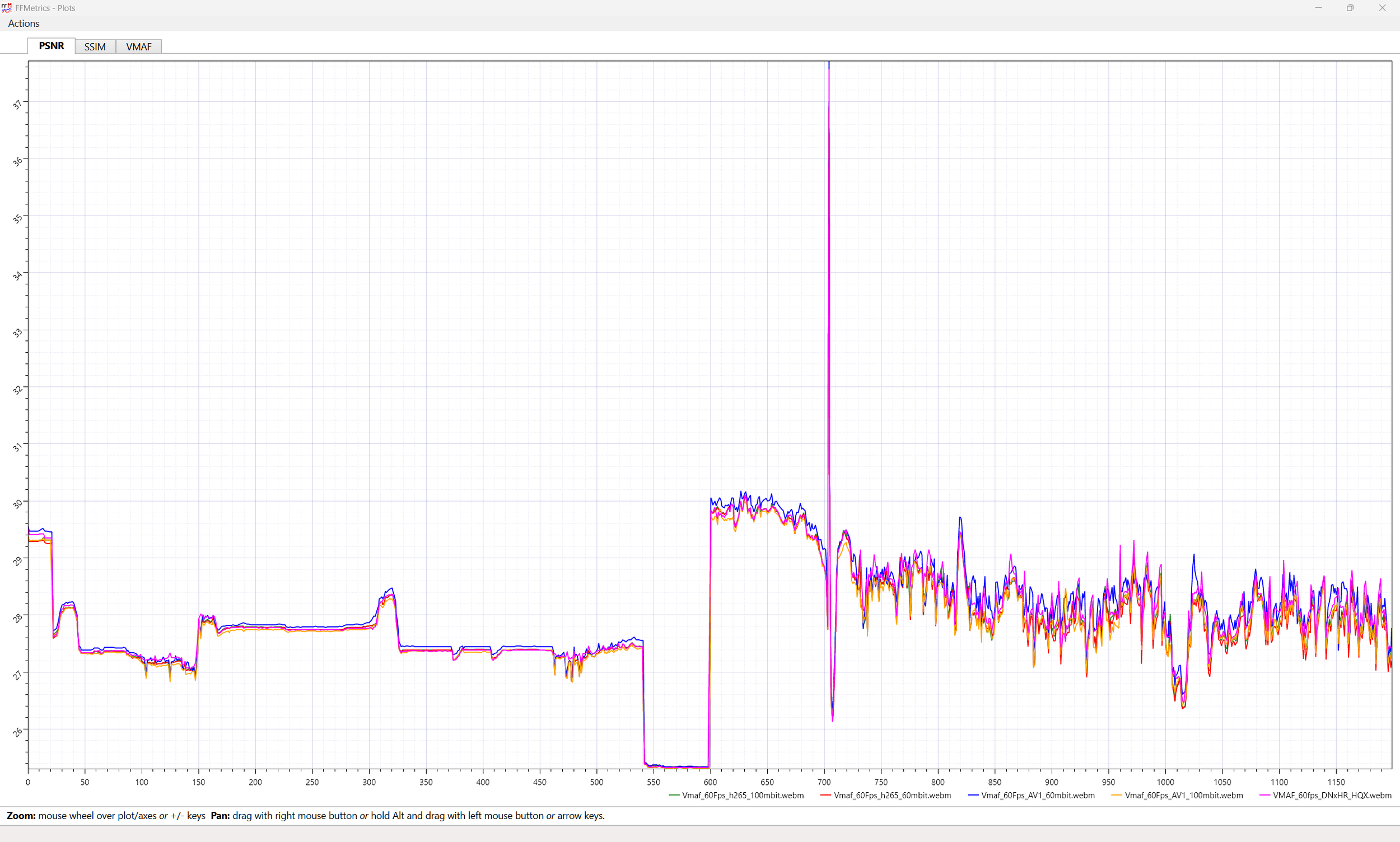
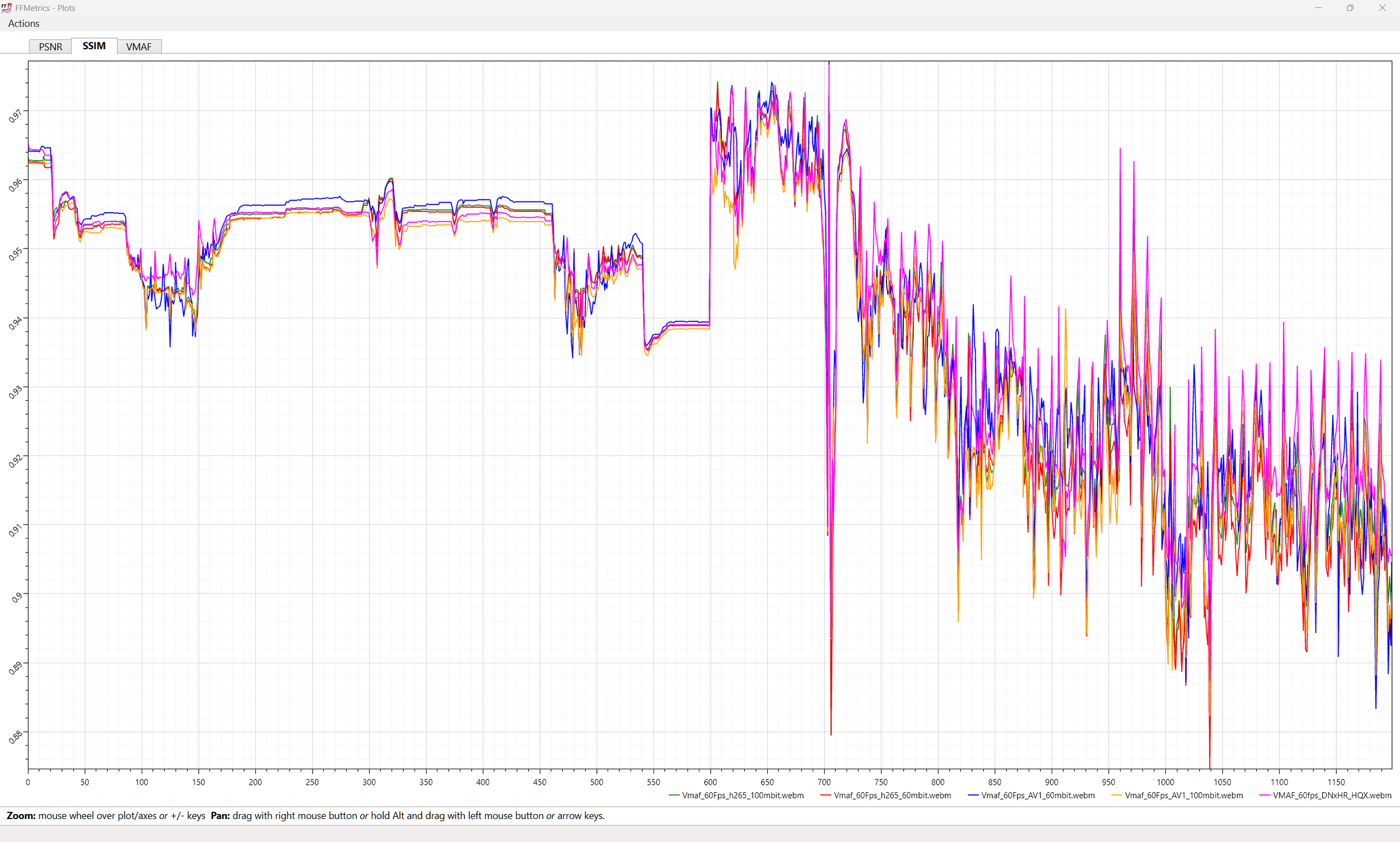
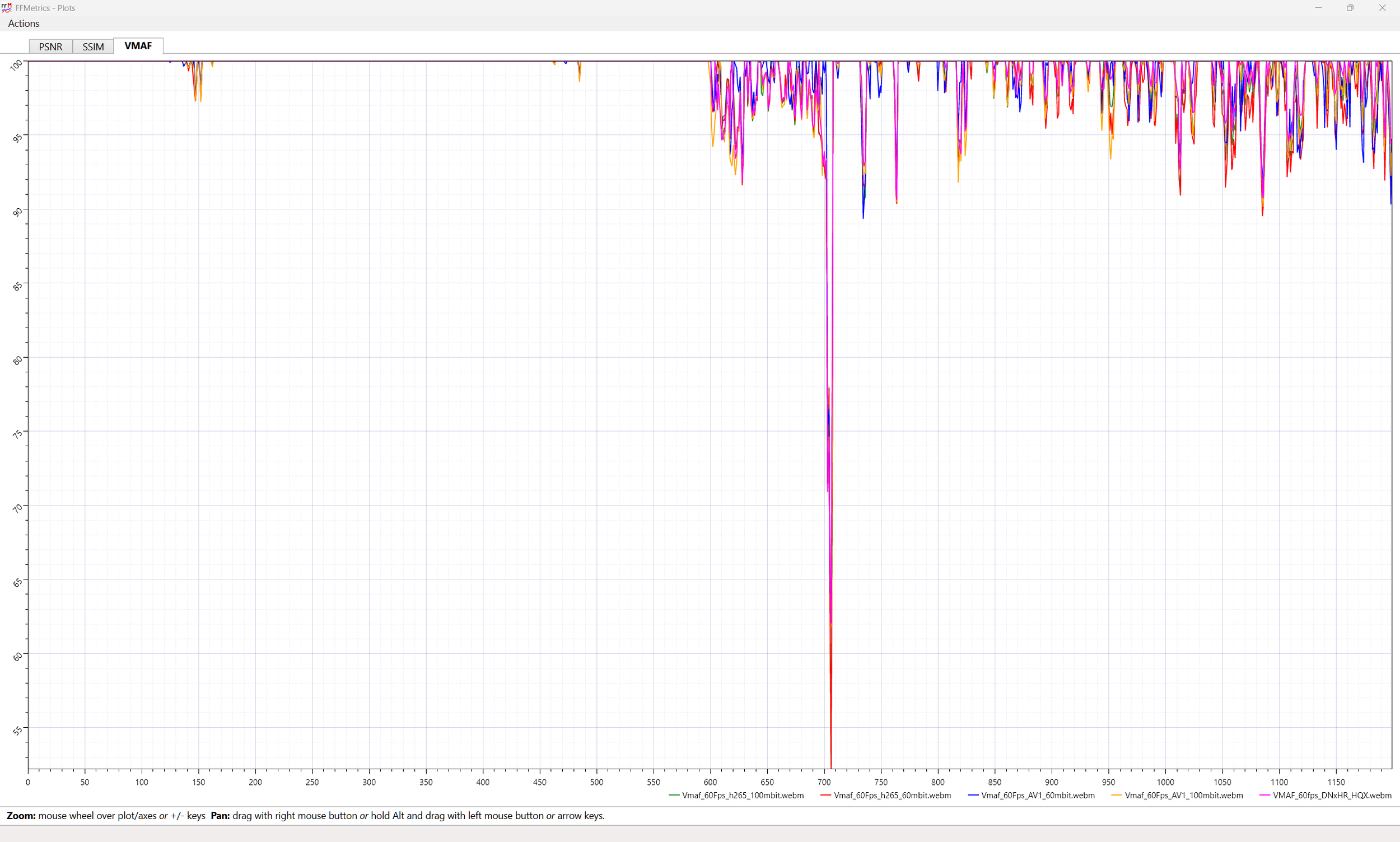
The game capture footage is apparently less stressful on the YT compression algorithms. While the 1750 mbit DnxHR HQX did produce the best VMAF at 99.39, the worst performer, H.265 60mbit was only 99.06, so not significantly worse.
Surprisingly AV1 60mbit out performed AV1 100mbit in all 3 tests, but again not by a significant amount. And it appears that 60fps uploads do not need additional bitrates over 24fps to get good results on YT. I did not test 60fps live action footage as I don't have any, and other than sports footage, I am not sure if it gets much use on YT?
Summary,
Don't upload 1080p. 4K and 1440p seem practically equivalent.
YT will accept high bitrate DnxHR HQX files, and if you have a very strong internet connection, you can just upload these and save the encoding time.
If you have hardware encoding for AV1, it at 60 mbit 10 bit seems to be the best image quality for reasonable file sizes.
Otherwise H.265 60 mbit 10 bit produced the best VMAF scores outside DnxHR and would be my choice if lacking HW encoding for AV1.
It appears that 60fps uploads do not need additional bitrates over 24fps to get good results on YT and either of the two recommendations above work well for 24 and 60fps.